Showing posts with label Respighi Ottorino. Show all posts

Saturday, September 1, 2012

Respighi: Concerto in Modo Misolidio


“Oramo and his Finnish players to give us a highly atmospheric reading of exemplary clarity and, in the "Trevi", powerful dramatic effect.” --Gramophone Magazine, December 2010

“Mustonen has a genuine feel for the [Concerto's] most poetic moments and the way they fit into the greater scheme of things...Sakari Oramo would seem to be in total agreement with him, leading the magnificent Finnish Radio SO in a truly outstanding performance” --International Record Review, December 2010


“Fountains of Rome is wholly engrossing: this is a fine performance very well-captured.” --Classic FM Magazine, January 2011 ***

“Respighi’s grandiloquent Concerto in the Mixolydian Mode of 1925 is a magnificent testament to piano opulence, fully expounded here by Olli Mustonen...Oramo and his Finnish forces provide the finesse and atmosphere” --The Telegraph, 2nd September 2010 ****

Saturday, June 30, 2012

Respighi: Belkis Suite, Dance of the Gnomes, The Pines of Rome


Grammy® Nominated: Best Engineered Album, Classical

"Colorful,thrilling performances of BELKIS, as Respighi would have preferred, and of the quirky gnomes piece, delivered in superb sound, makes this a compulsory purchase for every Respighi devotee." -- Ian Lace, FANFARE (Also, chosen for his WISH LIST -- one of the five best releases of 2001.)

"Stunning accounts of BELKIS and PINES OF ROME." -- Haller, AMERICAN RECORD GUIDE


"Respighi has not sounded like this on discs since -- well, let's say since never before. . . Of the seven Oue/Minnesota CDs I know, this is easily the grandest, musically as well as sonically." -- Roger Dettmer, ClassicalCDReviews

"This is exceptional work, even by Reference Recordings' own high standards. To the expected dynamic range, low-frequency definition, and clear imaging -- all by now hallmarks of digital processing -- this disc adds a gratifying sense of breathing space around the instrumental sound, such as was previously only heard on specially mastered LPs. 

The crescendos don't merely get louder -- the textures fill out and blossom. The climaxes surge without taking on a glossy veneer. The brass reproduction, minus the hard edge that frequently passes for "impact," is particularly open and airy, but the soft music is equally, tangibly vivid." -- Steve Vasta, CDNOW

MP3 320 · 143 MB

Tuesday, March 27, 2012

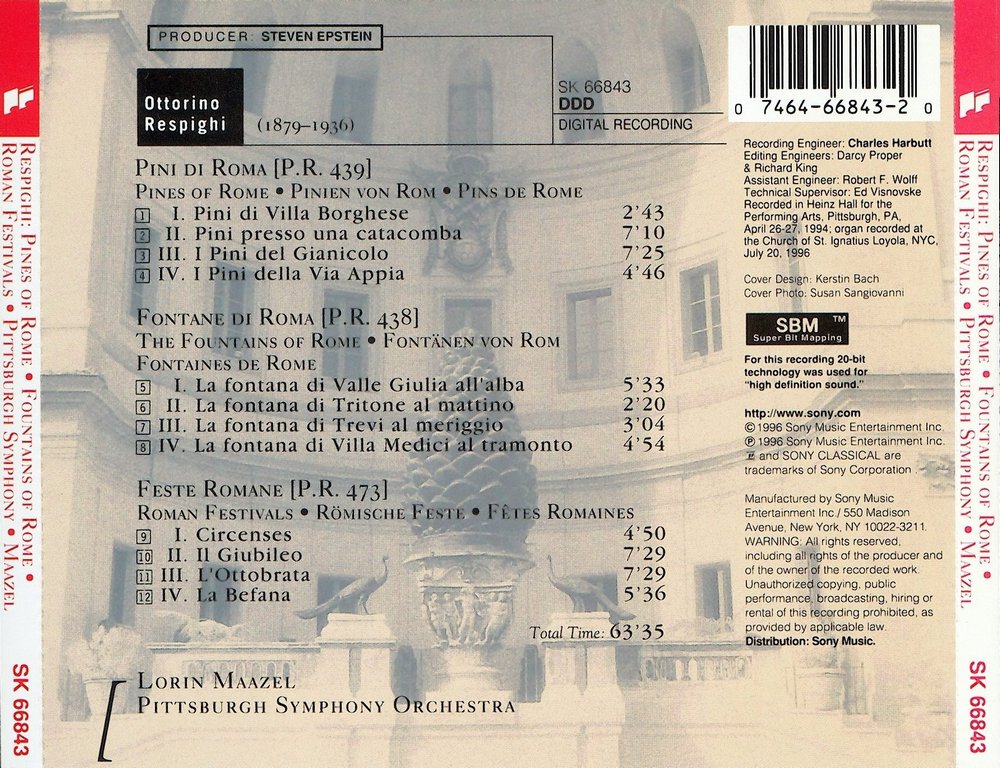
Respighi: Pini di Roma, Feste Romane, Fontane di Roma


This is such an exceptionally fine recording that in praising it to the skies I risk understating Maazel’s affectionate as well as brilliant performances. But then, as a note from the recording producer points out, the technique he has used would only work with the combination of an outstanding orchestra, a fine acoustic and a conductor in total control of the orchestral balancing. Only two microphones were used (supplemented, of course, by others for the separately recorded organ and the off-stage brass) and only two tape tracks, making it quite impossible to ‘improve’ the balance later. 


The gains, to one who has always been dubious about ‘multi-miking’ anyway, are immediately obvious and I would have said unanswerable. The orchestral sound is perfectly natural and perfectly believable; the acoustic is both perceptible and credible; Respighi’s textures are satisfyingly rich but always comprehensible; instruments are in the right perspective, and when a solo line is prominent there is no sense that it has been artificially spotlit or moved forward.

The sound is genuinely realistic, in short: just what you hope to hear from a good seat in a better than average concert-hall. Once you’ve got over the pleasurable relief of hearing such a sound again, you notice of course what a splendid orchestra this is: in Pines alone, what wonderfully velvety strings to evoke the shadows of the pines near a catacomb, what sensitive woodwind soloists as companions to the nightingale (poetically distant but beautifully clear) on the moonlit Janiculum! And then, trusting the balances as Maazel’s own and not half-wondering whether your compliments ought not to be awarded to the engineers, you enjoy not only the fine control of his big crescendos in the second and fourth movements, but the fact that you don’t have to fiddle with the volume controls to appreciate both the quiet and the loud ends of those crescendos.

His ear for shadings and contrasts of colour is sharp; so is his realization of how much of the drama of this music is dependent on a sense of orchestral space: the solo horn audibly behind the hushed strings in “L’Ottobrata”, the orchestra a sort of spatial analogue for the Colosseum in “Circenses” (Nos. 3 and 1 of Festivals respectively). Sony’s booklet, artfully, is in monochrome; the sound is not only in full colour but in three-dimensional relief. It is quite stunning, and under its immediate impact I can’t think of any modern recording of Respighi’s Roman pictures (not even that of Jansons) that approaches it.' --Gramophone 6/1997, Michael Oliver

MP3 320 · 138 MB